Soakaway Not Draining: Common Causes and How a CCTV Survey Provides the Answer
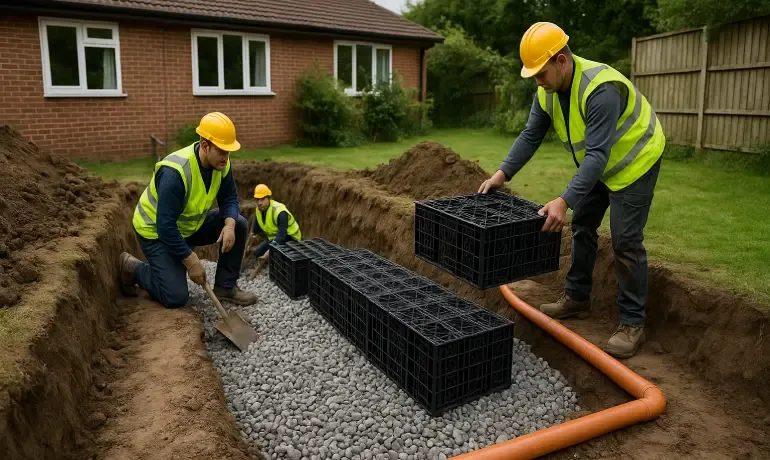
A soakaway failure is a drainage problem that demands precise diagnosis. We outline the common causes, from siltation to structural collapse, and explain why a CCTV survey is the only way to document the exact fault.
Why a Failing Soakaway Requires a Procedural Diagnosis
When a soakaway stops draining effectively, the symptoms are clear: water backing up, slow-draining gullies, or persistent surface water. However, the root cause is hidden underground. Guessing at repairs is inefficient and often ineffective. Our approach is grounded in diagnostic credibility, using CCTV survey technology to move from symptom to documented evidence of the fault.
Common Causes of Soakaway Failure
The primary function of a soakaway is to allow surface water to percolate slowly into the surrounding soil. Failure occurs when this process is blocked. The most frequent causes we identify through our surveys are:
Siltation and Sediment Build-up: Over years, fine particles wash into the system, settling in the soakaway crate or rubble chamber. This creates a dense, impermeable layer that prevents water from escaping into the ground. A CCTV survey can measure the depth of silt, documenting the extent of the blockage.
Structural Collapse or Damage: Soakaways, especially older brick or rubble-filled types, can degrade. Crates may buckle under soil pressure, or a land settlement can crush the structure. Our cameras provide visual confirmation of any collapse, showing whether the void necessary for drainage still exists.
Root Intrusion from Nearby Vegetation: Tree and shrub roots are drawn to the moisture in a soakaway. They can penetrate weak joints or cracks, growing within the structure and forming a dense mat that blocks water flow. CCTV footage clearly identifies root strands and their point of entry.
Ground Conditions and Seasonal Water Table: The surrounding soil's ability to absorb water is critical. In periods of heavy, sustained rainfall, the local water table may rise above the base of the soakaway, rendering it temporarily ineffective. Furthermore, soil compaction over the area can drastically reduce permeability.
The CCTV Survey: The Definitive Diagnostic Procedure
Identifying which of these issues is affecting your property cannot be done by excavation alone. A CCTV drain survey is the non-invasive, evidence-led procedure we employ. Our engineers deploy a flexible, articulated camera into the drainage system, tracing the pipework directly to the soakaway.
This process delivers a precise diagnosis. We can visually confirm if the inlet pipe is blocked, if the chamber is full of silt, or if structural integrity is compromised. The survey records high-resolution footage and generates a report that documents the findings. This report serves as the factual basis for any recommended remedy, whether that is jetting, excavation, or a new soakaway installation.
Without this evidence, any proposed solution is speculative. With it, the scope of work is clearly defined, and repairs can be targeted, saving time and avoiding unnecessary disruption to your property.
If your soakaway is not draining, the next step is a systematic investigation. Our diagnostic process begins with a CCTV survey to move from observing the symptoms to understanding the documented cause, ensuring the correct solution is implemented from the outset.
Frequently asked questions
Can a soakaway be repaired without being dug up?
In limited cases, such as severe siltation blocking the inlet, high-pressure water jetting via access points may offer a temporary improvement. However, for most structural failures, root infestations, or complete siltation, excavation and repair or replacement are necessary. A CCTV survey determines the exact condition, confirming whether excavation is required.
How does a CCTV survey find my soakaway?
Our engineers trace the surface water drainage system from the gullies or downpipes. Using the camera, we follow the pipework to its termination point, which is the soakaway. The camera's locator head transmits a signal to the surface, allowing us to accurately map its position and depth, even if its location was previously unknown.
What does the CCTV survey report include?
The report provides a written summary of findings alongside still images and video footage timestamped to show key defects. It will note the condition of pipes, the state of the soakaway chamber (e.g., 'collapsed', 'silted to 80% capacity'), and any root intrusion. This documented evidence forms the basis for our remedial recommendations.